Why AI Adoption Is Becoming an Operating Model Challenge
The question is no longer whether organisations will adopt AI. The question is whether they are built to manage it continuously.
The Traditional Assumption
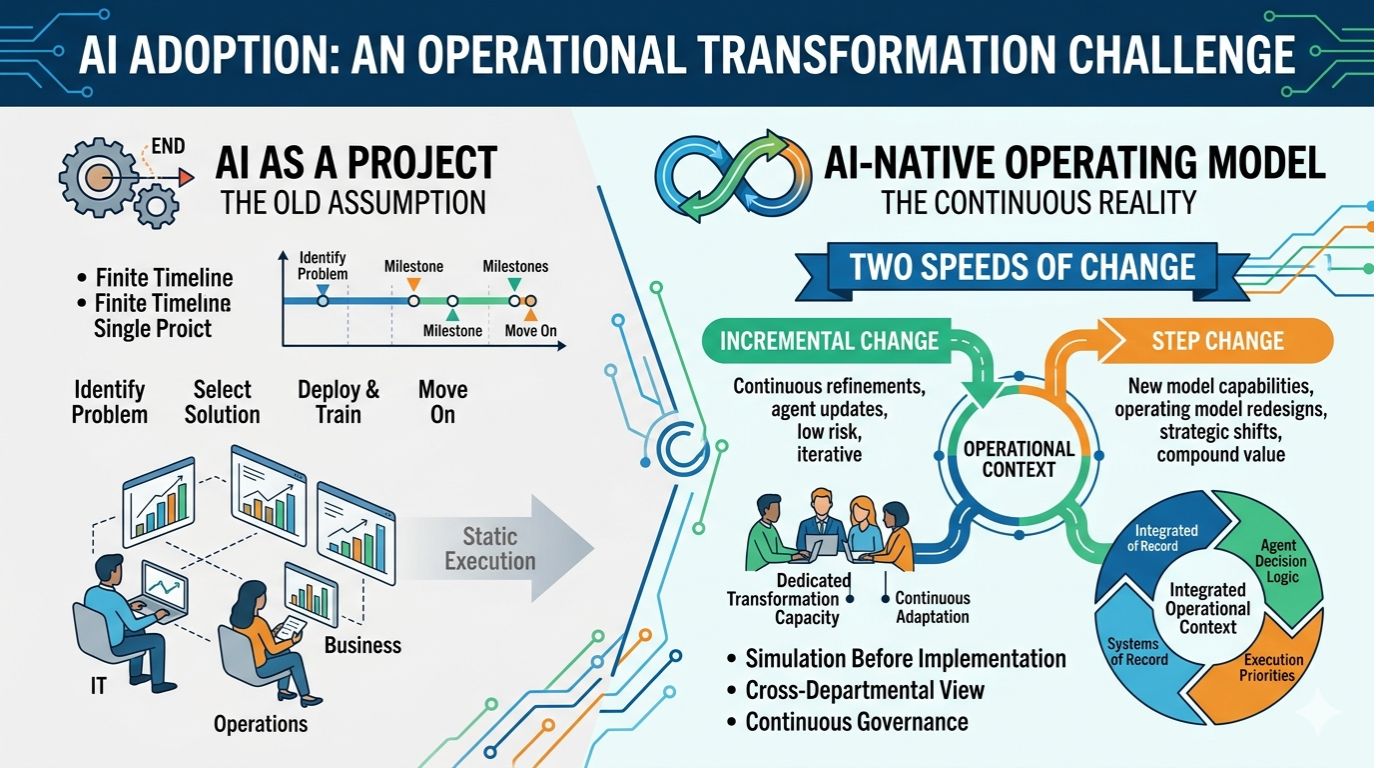
For most of the last decade, enterprise technology adoption followed a familiar pattern. Identify a problem. Select a solution. Deploy it. Train users. Move on.
That model worked reasonably well when the technology was stable, the implementation was finite, and the primary challenge was change management.
AI breaks every one of those assumptions.
Models improve continuously. Agent capabilities expand. Customer expectations shift in response to what AI makes possible. Competitive baselines reset faster than most annual planning cycles can track.
The target keeps moving.
And organisations that treat AI adoption as a project with a defined start, a deployment milestone, and a handover to business as usual are discovering that business as usual no longer exists in the form they expected.
Two Speeds of Change
The integration challenge is complicated by the fact that AI-driven change operates at two distinct speeds simultaneously.
The first is incremental change. Prompt refinements. Workflow improvements. Agent updates. These are continuous, relatively low-risk, and can be managed through structured iteration if the right capacity exists.
The second is step change. New model capabilities that fundamentally alter what's possible. New operating model designs that emerge as AI matures. New business opportunities that didn't exist six months ago. New organisational structures required to capture them.
Most organisations are architected for projects, not for managing both speeds of change simultaneously and continuously.
The result is a predictable pattern. An AI initiative succeeds at the pilot stage. The organisation celebrates and scales. And then, quietly, the drift begins. The context the system was built on becomes outdated. The workflows it was designed around evolve. The decisions it was trained to support shift in priority. Nobody owns the ongoing adaptation. The initiative gradually becomes less effective without anyone being able to explain exactly why.
The Ownership Gap
This is where the real integration challenge lives, not in the technology, but in the organisation.
Who owns experimentation when a new capability emerges? Who evaluates whether an existing workflow should be redesigned? Who monitors agent performance over time and decides when intervention is required? Who manages the interaction between human judgment and AI execution? Who decides when incremental improvement is sufficient and when a step change is needed?
In most organisations, the honest answer is: nobody, clearly.
These responsibilities get distributed informally across IT, operations, and individual business units, each managing their corner of the AI estate without a shared view of how the pieces interact, where the risks accumulate, or where the highest-value adaptation opportunities lie.
That fragmentation is manageable when AI is peripheral. It becomes a serious operational risk when AI is embedded in core decision-making, customer-facing processes, and revenue-generating workflows.
What Effective Transformation Capacity Looks Like
The organisations navigating this well are not necessarily the ones with the largest AI budgets or the most sophisticated technology stacks. They share something more structural.
They have dedicated, ongoing transformation capacity, not a large programme management office, not a one-time change initiative, but a small, cross-functional capability responsible for continuously understanding, prioritising, and managing AI-driven adaptation across the business.
Several characteristics distinguish effective transformation capacity from traditional project teams.
The first is a clear statement of organisational intent that AI systems can reason over. Not a company knowledge base that ingests every email and document. A structured, maintained expression of what the business is trying to achieve, how it makes decisions, what constraints govern execution, and where the priorities lie. Without this, AI systems operate from whatever context they're given in the moment, which varies by user, by workflow, and by day. Consistency of execution requires consistency of context.
The second is defined iterative roles rather than static job descriptions. Effective AI-native teams operate more like a standing sprint team than a department, with clear responsibilities for opportunity identification, context management, decision governance, quality monitoring, and continuous improvement cycling in structured cadences. The capability to manage this needs to live on the business side, not in engineering. Engineering involvement is essential for complex service development. But the ongoing adaptation of workflows, decision logic, and operational context should not require an engineering ticket every time something needs to change.
The third is a cross-departmental view of opportunities. The highest-value AI opportunities rarely live within a single product or department. They emerge at the boundaries, where sales context meets product capability, where operational data meets customer insight, where market signals meet decision architecture. Organisations that manage AI adoption department by department miss the compound value that comes from cross-functional coherence.
The fourth is a single source of operational truth. Systems of record, CRM, ERP, data warehouses, are not going away. But they were designed to store what happened, not to govern what should happen next. Effective AI-native operations require a layer above them: an integrated operational context that connects systems of record to decision logic, governance rules, and execution priorities. Without that integration, AI agents operate from disconnected data sources and produce inconsistent outcomes.
The fifth is simulation before implementation. One of the most underused disciplines in AI transformation is the structured stress-testing of operating model designs before they go into production. Testing whether decision architecture produces reliable outcomes across different scenarios. Validating whether governance models hold under edge cases. Confirming that the assumptions the design rests on are actually valid. The cost of discovering a design flaw during simulation is negligible. The cost of discovering it after deployment, particularly when AI has been scaling that flaw across thousands of decisions, is not.
The sixth is deliberate de-risking through parallel capability rather than single-team dependency. Organisations that run their entire AI-native operation through one central team create a concentration of risk that compounds as AI becomes more embedded in critical processes. Competing teams working on defined problem spaces, able to test, learn, and iterate independently, distribute that risk and accelerate learning velocity simultaneously.
The F1 Problem
There is a useful analogy for the challenge that AI-native operations creates.
AI enables extraordinary speed. Decisions get made faster. Workflows execute faster. Market signals get processed faster. Opportunities get identified faster.
But speed without precision architecture doesn't improve performance. It amplifies error.
An F1 car travelling at two hundred miles per hour is a remarkable achievement of engineering. It is also a system where any minor miscalibration, in the aerodynamics, the telemetry, the decision-making of the driver, can produce catastrophic consequences almost instantly.
AI-native operations work similarly. The faster the system runs, the more consequential the quality of the underlying architecture becomes. A misaligned decision rule, an outdated context layer, an ungoverned agent operating outside its intended boundaries, at low speed these are manageable problems. At the speed AI enables, they become serious operational risks before most organisations have time to detect them.
This is why architecture, governance, and continuous adaptation capacity are not optional disciplines for AI-native organisations. They are the engineering that makes the speed safe.
The Defining Challenge Ahead
The organisations that succeed in the AI-native era will not necessarily be the ones that deploy the most technology. They will be the ones that build the organisational capacity to continuously adapt as AI capabilities, market conditions, and competitive expectations evolve.
That requires a different kind of management discipline than most organisations have developed. Not project management. Not change management in the traditional sense.
Continuous transformation management, the ongoing capability to understand what's changing, decide what matters, design better systems, test them before committing, and improve them over time.
The technology to enable this exists. The organisational structures to manage it are only beginning to emerge.
That gap, between what AI makes possible and what organisations are built to manage, may prove to be the defining operating challenge of the next decade.
What Enterprise AI Architecture Actually Requires
| What Successful AI Transformation Requires | VisionList Operating Mechanism |
|---|---|
| Opportunities: Clear understanding of market changes and emerging opportunities | Phase 0: Understanding & Strategic Positioning establishes a reasoned organisational position on AI-native transformation before implementation begins. |
| Path: A structured path from uncertainty to execution | The 5-Step AI-Native Transformation Method and 5-Phase Roadmap provide a repeatable transformation process. |
| Intent: Shared understanding of goals, priorities, assumptions, and intended outcomes | The Unified Context Layer (UCL) creates a structured business dataset that humans and AI can operate from consistently. |
| Operating Model: A target operating model for humans, agents, workflows, and systems | The AI-Native Operating Blueprint defines operating models, workflows, services, decision systems, and governance structures. |
| Decisions: Clear ownership and accountability for decisions | Agent Rule Definitions (ARDs) make responsibilities, permissions, escalation paths, and decision boundaries explicit. |
| Decision Prioritisation: Structured prioritisation of decisions and transformation initiatives | 4-Quadrant Decision Architecture categorises decisions by determinism, uncertainty, risk exposure, and value creation potential, providing a practical framework for prioritisation. |
| Capability: The right combination of skills, roles, and organisational capability | The Team of Six model provides a reference architecture for balancing human expertise, AI agents, and transformation responsibilities. |
| Validation: Validation before large-scale deployment | Simulation & Validation tests assumptions, architectures, workflows, and operating models before implementation. |
| Adaptation: Continuous adaptation as technology and markets evolve | Sprint-based learning cycles and Operational Intelligence provide ongoing feedback, prioritisation, and redesign. |
| Leverage: Preservation of organisational knowledge and learning | The VisionList platform as a System of Record for Organisational Intent retains context, decisions, assumptions, outcomes, and learnings over time. |
In summary, traditional architecture focuses primarily on technology. AI-native architecture increasingly requires equal attention to operating models, governance, decision systems, organisational capability, and continuous adaptation. The challenge is not simply deploying AI. It is creating an organisation capable of evolving alongside it.
Author: Azfar Haider, Creator, VisionList
1st June 2026
About VisionList
VisionList is a transformation method and supporting platform designed for organisations navigating growth, complexity, and AI-native change.
It is intended for leadership teams, operators, architects, and transformation leaders responsible for helping their organisations adapt as markets, customer expectations, technologies, and operating models evolve.
Unlike traditional consulting approaches that focus primarily on strategy, or software platforms that focus primarily on execution, VisionList combines both. The method helps organisations identify opportunities, align stakeholders, design operating models, define decision systems, and continuously adapt over time. The platform provides the continuity required to capture context, decisions, assumptions, workflows, and organisational learning throughout that journey.
We believe successful AI-native organisations will not be defined solely by the quality of their technology. They will be defined by their ability to learn faster, make better decisions, and continuously evolve. VisionList exists to support that capability.
If you'd like to learn more, book a discovery call.