Pre-AI, organizations could afford to under-define problems.
A short problem statement was enough because humans filled in the gaps during execution: judgment, exceptions, priorities, and trade-offs lived in people's heads.
AI breaks that model.
When a problem isn't fully defined, AI must infer what matters — often producing outputs that are plausible, inconsistent, or misaligned across tools and teams.
This isn't a model limitation. It's a missing problem definition.
Why "More Prompts" Doesn't Fix It
Most teams respond by:
- refining prompts
- adding instructions
- extending conversations
- layering tools
But this only shifts the burden.
The underlying issue remains: the system still doesn't know what good looks like in this business, for this situation, right now.
Context as a First-Class Asset
In an AI-native organization, context is not supporting documentation. Context is the full picture of the problem.
That includes:
- goals and success criteria
- constraints and boundaries
- trade-offs and risk tolerance
- decision ownership
- exceptions and escalation paths
VisionList captures this as a structured, living problem state — not a static document.
Why Context Must Evolve in Sprints
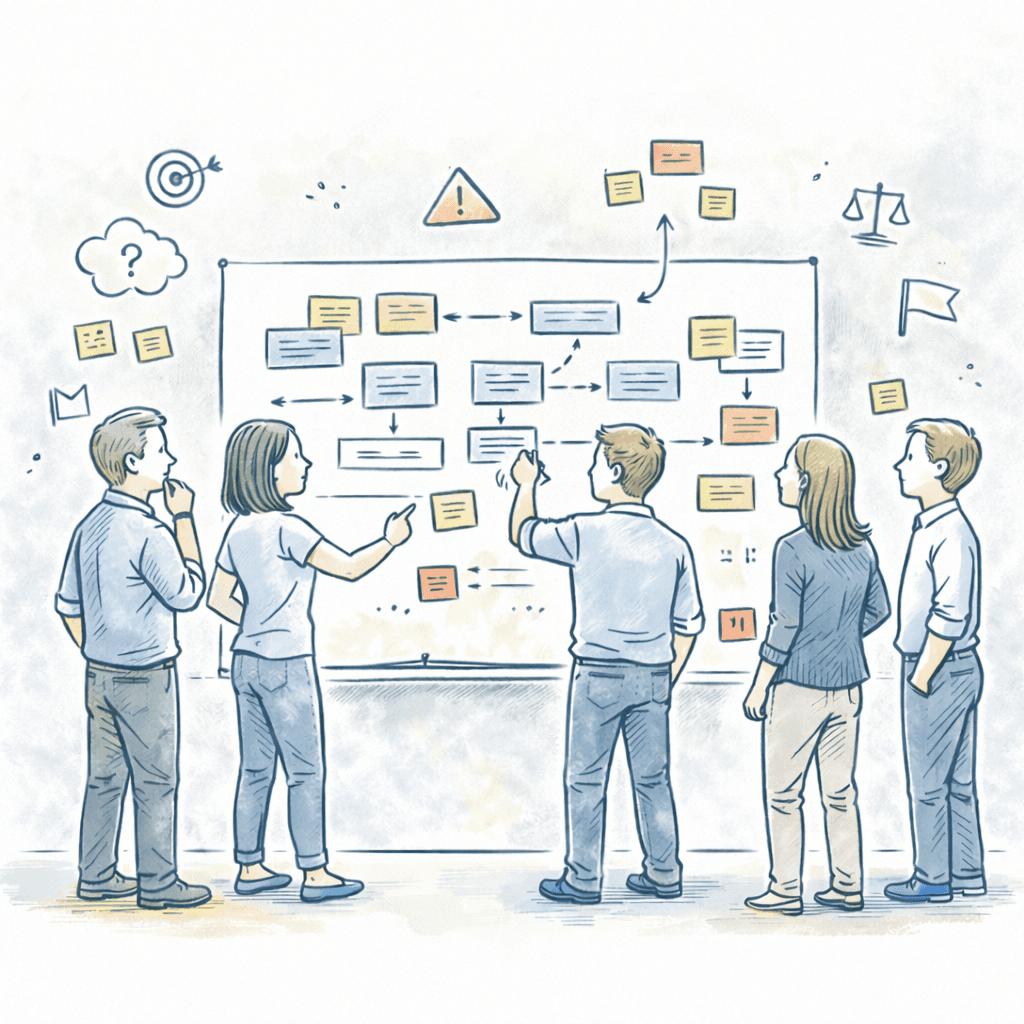
No organization can define the full problem in one sitting. Information is fragmented, rules conflict, priorities change, and exceptions emerge.
That's why VisionList uses sprints: not just to execute work, but to converge on clarity.
Each sprint:
- surfaces missing context
- reconciles contradictions
- turns assumptions into decisions
- updates the shared truth
The output isn't just progress. It's a better-defined problem.
The Compounding Effect
Once context becomes explicit:
- new options appear
- better decisions become obvious
- strategies change
- the original goal often evolves
This is the paradox: AI demands clarity — but clarity changes what you choose to do next.
So, context is never "done". It becomes an operating layer the business continuously updates and relies on.
What This Enables
When context is explicit and current:
- AI agents behave predictably
- automation becomes safer
- exceptions are owned by design
- humans and AI collaborate instead of compensating for ambiguity
This is the foundation VisionList provides: an operating layer where context, decisions, and execution stay aligned as the business evolves.
Continue Reading
Ready to make context a first-class asset?
VisionList helps you define, maintain, and evolve the context your business and AI need to operate reliably.